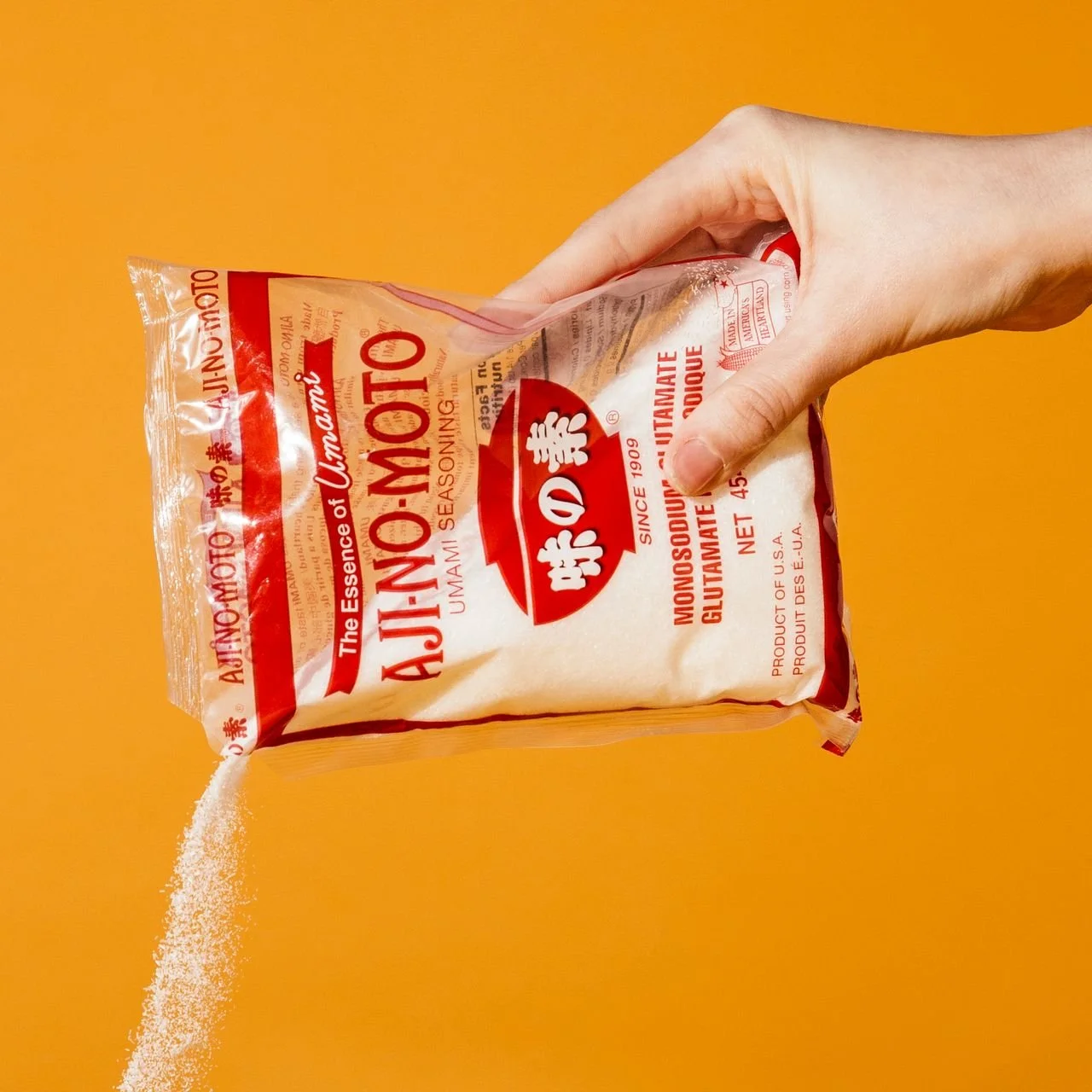
Rebranding MSG (no, not Madison Square Garden)
As a final project for a branding course taught by Tosh Hall at SVA, we were tasked to reposition a brand that had fallen out of fashion. Our team pitched monosodium glutamate—as in MSG—and successfully presented it to branding executives from Jones Knowles Ritchie and Turner Duckworth, who hailed it as “a master class in persuasion.” (We brought out little bowls of MSG for them to try!)
While this is speculative work, I love talking about this project because it combines two of my favorite topics: food and the power of a name.
THE CHALLENGE
Monosodium glutamate (MSG) is naturally found in everything from mushrooms to tomatoes. However, myths about the side effects it supposedly causes persist. 4 in 10 Americans say they still avoid MSG. Consumers see it as an artificial additive. How can Ajinomoto reposition MSG as a flavor enhancer that’s safe to use and consume?
THEINSIGHT
Chemical-sounding ingredients (as well as the use of acronyms in food) elicit skepticism. What if your doctor told you they found staggering amounts of dihydrogen monoxide in your body? It’s something you’ve been consuming daily, unknowingly. That’s because dihydrogen monoxide is most commonly known as H2O, or water. But we never call it dihydrogen monoxide, for good reason.
Food has a long history of being renamed in order to sound more palatable: rapeseed oil became canola. Patagonian toothfish was rebranded as the swanky-sounding Chilean seabass. Mahi-mahi was originally called dolphin fish, but was renamed because no one wants to think about eating beloved dolphins, even if it’s not the same kind of fish. Restaurants charge a premium for uni, leveraging the ingredient’s Japanese name, though they are essentially the edible reproductive organs (the gonads—yes, the gonads) of sea urchins.
THE STRATEGY
While MSG has been vilified, the term umami—which Kikunae Ikeda invented along with MSG—has risen in popularity. Ajinomoto has recently spearheaded efforts to reclaim the MSG name with their “Know MSG” campaign (a spin on “No MSG” signs frequently seen in restaurants). However, MSG’s checkered reputation may be too much to overcome in many consumers’ minds. To truly establish the ingredient as a flavor enhancer, it should leverage MSG’s shared history with umami and lean into the umami seasoning name (which they already use on packaging), leaving MSG behind entirely. Because MSG is good and does make things taste better. It deserves a place in every pantry and spice cabinet, alongside sodium chloride—or as we call it, salt.
Team: Maureen Martinez, Juliana Valero, Martin Zhang, Felix Yu